
Former NSE managing director (MD) and chief executive officer (CEO) Chitra Ramkrishna and group operating officer and her advisor Anand Subramanian ran a 'money-making scheme' during their stint at the National Stock Exchange (NSE), markets regulator Securities and Exchange Board of India (Sebi) has alleged. The order passed by Sebi dated February 11 highlights frequent increase in the compensation package of without proper appraisal, documentation or file notings, and the involvement of the human resource (HR) head or the nomination and remuneration committee. Furthermore, the order talks about Subramanian being directed to "withdraw and surrender" to the unknown person a gross amount per month as "gratitude".

'India has many attractive features for the long-term investor; it combines: A low per capita income, a young population, and a heavier presence of high margin, asset-light firms in the technology sector.'

Tata Consultancy Services (TCS) has bagged -- from the Ministry of External Affairs -- the contract for delivering electronic passports (e-passports), according to sources. This deal is in addition to the second phase of implementing the Passport Seva Program, which the company got from the ministry. Players such as Thales India and HP participated in this deal, which is expected to be of Rs 1,000-1,200 crore.
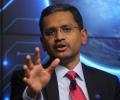
Infosys has emerged as the fastest growing IT services brand following 52 per cent brand value growth since last year and 80 per cent since 2020 to $12.8 billion, earning it third spot, the brand valuation consultancy said in its latest Global 500 IT Services Ranking report. TCS and Infosys have pushed IBM to fourth spot from second. IBM's brand value now stands at $10.6 billion, a decline of 34 per cent from last year and 50 per cent since 2020.
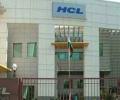
HCL Technologies plans to double its fresher hiring for the upcoming financial year (FY23) as attrition continues to inch up. The company said that it will hire 40,000-45,000 freshers for FY23, up from 20,000-22,000 target for FY22. The company also stated that to ease supply-side constraints and to have access to diversified skills, it was expanding into other geographies over the next three-four quarters. "Some of the geographies that we are investing in to source talent include countries like Romania, Hungary, Bulgaria, Guatemala, Costa Rica. We are also ramping up our presence in Sri Lanka, Vietnam, Australia, New Zealand, etc.

The analyst community tracking the Indian IT services industry took special note of Accenture's first quarter (Q1) performance, which showcased the rapid growth of its consulting business that outperformed its outsourcing business. Bookings indicate that the trend will continue. Consulting bookings increased 41.6 per cent year-on-year (yoy) to $9.4 billion, higher than the 17.6 per cent growth in outsourcing to $7.4 billion. The management commentary was also more bullish on the consulting business.

Byju's, Flipkart, PharmEasy and CRED, among others, have taken the acquisition route to grow

Will 2022 be a year of contrasting narratives -- one filled with caution and the other with continued optimism?

Accenture's Q1 FY22 results have sent a wave of cheer among analysts, as the company raised its revenue guidance and said it expects double-digit growth in outsourcing, up from single digit to low double-digit growth expected earlier. Accenture's financial year ends on August 31. The company raised its revenue outlook for FY22 to 19-22 per cent in local currency, up from 12-15 per cent earlier.

After dropping to a low of Rs 1,298 apiece, the stock finished at Rs 1,380, its lowest level since November 22, the second day of listing.

'The markets haven't corrected, that doesn't mean that they will only go up and up.'

The spread of the Omicron variant of the coronavirus has made Indian companies persist with their policy of banning overseas trips and allowing only essential travel within India. The IT services firms, which had planned to ask their employees to return to the workplace, are also waiting and watching the Covid-19 situation before fully opening up their offices. Large conglomerates like the Tatas, Birla, JSW and Reliance are continuing with the mandatory social distancing and masking policies within their office premises.

'In the overall global portfolio, India's weighting has come down in the past seven months.'

'Investing in the stocks of holdcos can be a very efficient and inexpensive way of gaining exposure to the stocks of India's reputable growing business houses.'

'Sebi has to make sure that investor interests are protected and at the same time, there isn't over-regulation so that companies don't get discouraged to list here.'

'They have helped stabilise our market by acting as a counterbalance to foreign funds.'

'We have focused on profitable revenue, cash generating businesses, throughout our journey.'

Star Health and Allied Insurance's Rs 7,250-crore initial public offering (IPO), the third largest this year and eighth largest ever, just about managed to make it despite a poor response from investors, garnering just 79 per cent subscription, forcing the investment bankers to prune offer for sale (OFS) component. This is the second large offering after digital payments major Paytm this year to receive a lukewarm response from investors, a sign that despite the IPO frenzy investors are discerning when it comes to pricing. As Star Health didn't meet the profitability criteria, its IPO required a mandatory 75 per cent subscription from qualified institutional buyers (QIB).

'Any normalisation exercise will bring its share of volatility.'
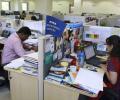
Moving over 520,000 employees to a digital work model is no mean feat. Having done so, Tata Consultancy Services (TCS) is taking these learnings to help clients digitise their work models. Swiss Re is one such client. For the global information technology services firm with a headcount of 528,748 as of end-September, the shift to a single human resource (HR) platform started a few months before the pandemic started, when TCS moved its HR solutions to Microsoft's platform. Siva Ganesan, global head, Microsoft business unit, TCS, still remembers the early days when TCS embarked upon a move from an existing software platform to a digital medium for communications on a Microsoft Office platform.
 © 2026 Rediff.com - Investor Information - Advertise with us - Disclaimer - Privacy Policy - Sitemap - Feedback - About us - Terms of use - Grievances